What does Fear of the Lord Mean?
- edwardstayler12
- May 26
- 4 min read

When considering Christianity, many concerns and questions may arise, particularly when committing to a God whom you may not have physically seen. To seek answers, people often turn to a pastor, attend church, or consult the Bible. However, navigating the Bible can be challenging, as it may be difficult to locate specific verses and fully understand their meanings.
Many people stop trying to understand the Bible because they find it difficult. Sometimes, we can be confused by its teachings. It's important to recognize that we will never fully grasp the Bible's messages or teachings without the guidance of the Holy Spirit and the wisdom of the Lord. 1 Corinthians 2:12-14 (NIV) states, "What we have received is not the Spirit of the world, but the Spirit who is from God, so that we may understand what God has freely given us. This is what we speak, not in words taught by human wisdom but in words taught by the Spirit, explaining spiritual realities with Spirit-taught words. The person without the Spirit does not accept the things that come from the Spirit of God but considers them foolishness and cannot understand them because they are discerned only through the Spirit."
When reading verses that mention having a fear of the Lord, it can be confusing to understand why a "God of love" would instruct us to fear Him. To clarify this, two important factors should be considered:
1) Wording and context
2) Definitions and meanings of specific words
Example of verses that use Fear of the Lord:
Proverbs 1:7 ( NIV) "The fear of the Lord is the beginning of knowledge; fools despise wisdom and instruction."
Proverbs 9:10 (NIV) "The fear of the Lord is the beginning of wisdom, and knowledge of the Holy One is understanding."
Psalm 111:10 ( NIV) "The fear of the Lord is the beginning of wisdom; all who follow his precepts have good understanding. To him belongs eternal praise."
Psalm 34:9 (NIV) "Fear the Lord, you his holy people, for those who fear him lack nothing."
Let's break down each verse and get the context and definitions of each verse.
Proverbs 1:7 states that the "fear of the Lord" results in knowledge. It is important to differentiate between "fear of something" and "fear something," as the phrasing differs and suggests distinct meanings. In this context, the Hebrew word for "fear of the Lord" is "Yirah," which encompasses three meanings: fear, awe, and reverence.
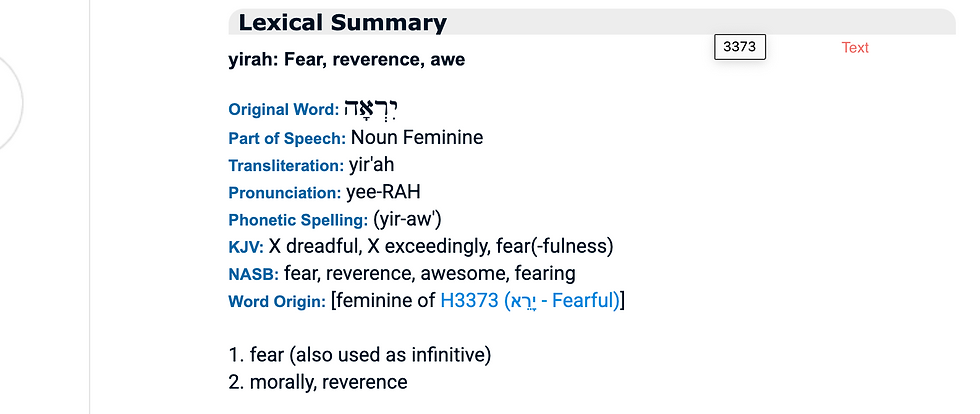
Reverence- means deep respect for someone or something.
The text discusses how the wording of proverbs emphasizes reverence for the Lord rather than instilling a bone-shaking fear. It suggests that having a deep respect for the Lord is the foundation of knowledge. This respect leads to an understanding of both the Lord and general knowledge. Such knowledge equips us with the information needed to make sound decisions and, over time, helps us develop the wisdom to not only recognize what is right but also to act upon it.
We know that we will never fully understand the ways of the Lord, as expressed in Isaiah 55:8-9: "For my thoughts are not your thoughts, neither are your ways my ways," declares the LORD. "As the heavens are higher than the earth, so are my ways higher than your ways and my thoughts than your thoughts." While we may never grasp why God does what He does—often referred to as the "ways of the Lord"—we can know who He is: the Alpha and the Omega, the Beginning and the End.
Some of His characteristics include omnipotence and omniscience. Understanding these attributes helps us form a foundation for recognizing God as the Lord of our lives. This knowledge of the Lord can be described as the "knowledge of the Holy One," as mentioned in Proverbs 9:10.
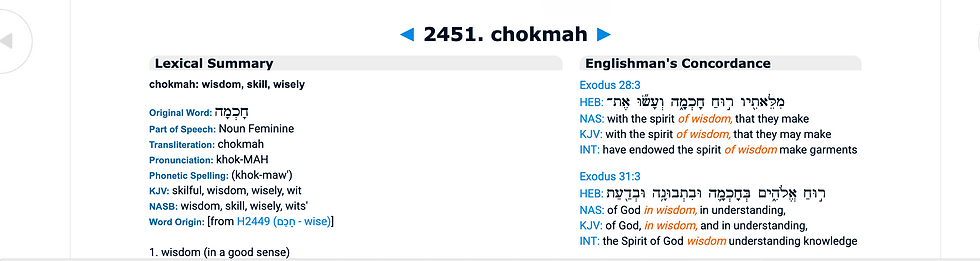
Psalm 111:10 highlights the concept of fear in relation to reverence and respect. This verse states that "The fear of the Lord is the beginning of wisdom." Wisdom involves putting knowledge into action; while you may understand something intellectually, it remains mere knowledge unless you act upon it. In this verse, "fear" denotes reverence for the Lord, and in Hebrew it is expressed as "chokmah," meaning good sense. Having good sense means being able to discern right from wrong, which ultimately guides one toward doing what is right.
Psalm 34:9 highlights the importance of reverent fear of the Lord, suggesting that this kind of fear leads to wanting for nothing. Having respect and reverence for God can fulfill our needs. This verse emphasizes obedience, which aligns with other scriptures such as Psalm 110 and Proverbs 9:10, which state that "the fear of the Lord is the beginning of wisdom." Wisdom here is understood as good sense that guides us in making wise choices.
This concept relies on the existence of laws or commandments to follow, which Christians have. Our faith provides us with these guidelines, which is why the verse addresses "His holy people"—those who choose to follow Him. Deuteronomy 13:4 reinforces this idea by saying, "It is the Lord your God you must follow, and Him you must revere. Keep His commands and obey Him; serve Him and hold fast to Him."
To summarize: Following and reverencing God leads to wisdom and fulfillment in our lives.
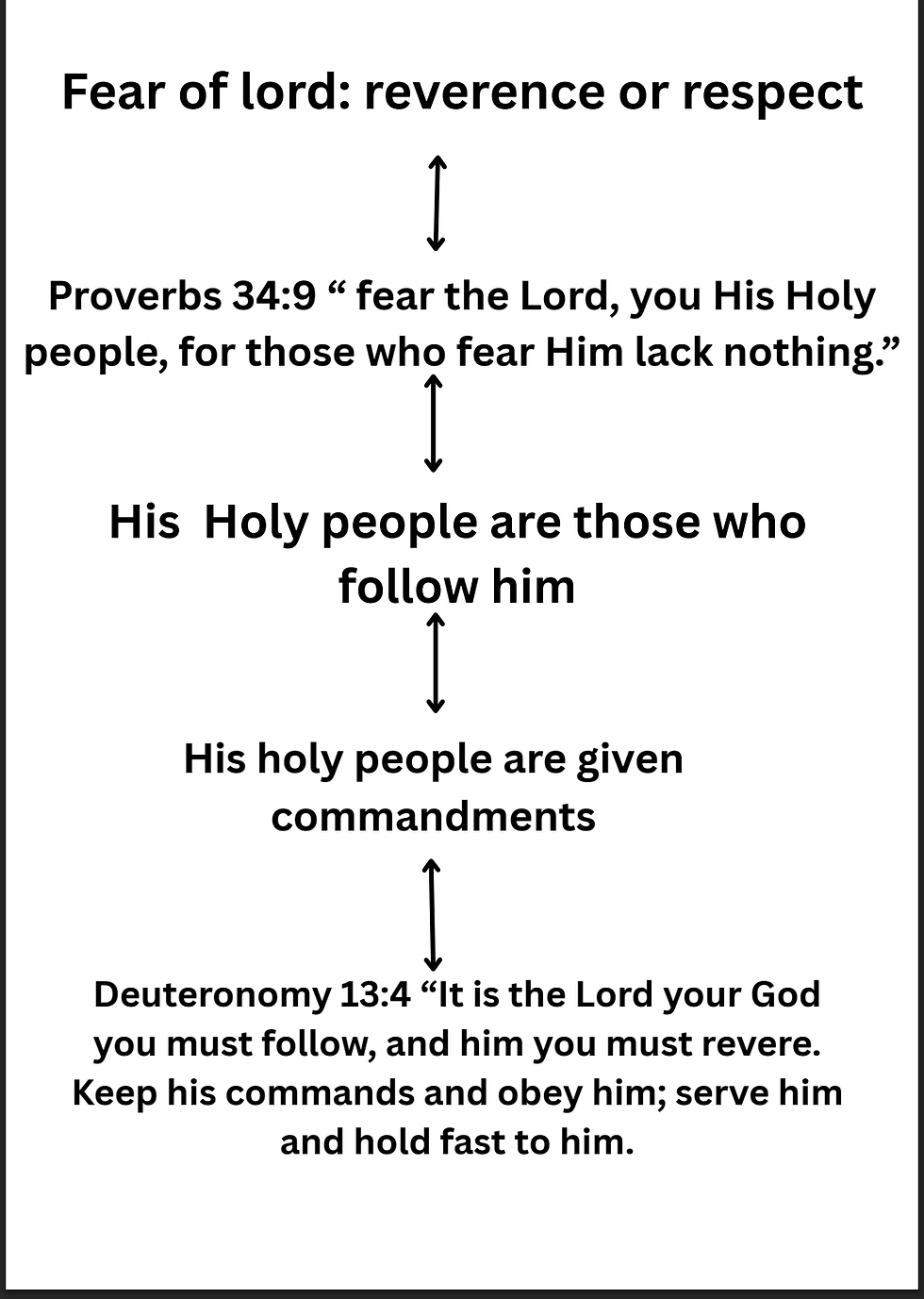
Reverence is synonymous with revere, indicating that this verse discusses the fear of the Lord in a respectful manner. It instructs His people to honor Him by keeping His commandments, demonstrating their obedience.
Most verses that discuss the "Fear of the Lord" refer to it in a reverent sense. If you're ever unsure about its meaning, it's a good idea to look up the definition of the word and consider the context. Often, the Bible explains its meanings within the same chapter or in nearby verses. A useful resource for looking up definitions is Bible Hub, which provides the original language in which the text was written and the meaning of words in that language. When reading the Bible and conducting research, always verify your sources and approach the material with an open mind!


Comments